The hepatic sink and how engineered carriers bypass it
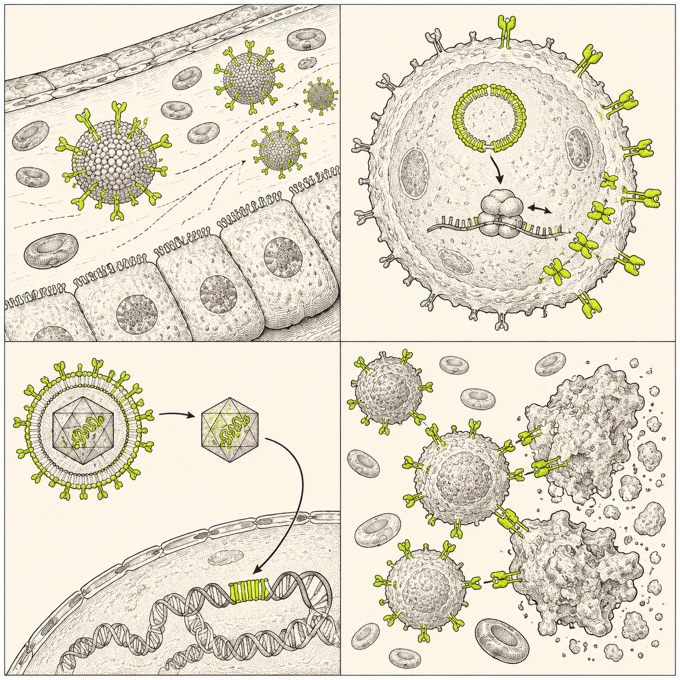
As outlined in our foundational plate on in vivo CAR-T cell generation, reprogramming lymphocytes directly in circulation promises to eliminate leukapheresis, multi-week cleanroom expansion, and toxic lymphodepleting conditioning. Yet between biological promise and clinical consistency sits an unforgiving anatomical barrier: the human liver acts as a high-capacity physiological sink for almost every systemically injected nanoparticle or viral capsid.
In conventional lipid nanoparticle formulations developed for mRNA vaccines, the neutral lipid shell rapidly adsorbs serum apolipoprotein E within seconds of intravenous infusion. That spontaneous protein corona funnels particles into hepatic sinusoids, where hepatocytes endocytose them via low-density lipoprotein receptors and Kupffer macrophages scavenge the remainder. When the therapeutic target is circulating or splenic T lymphocytes, hepatic trapping wastes most of the administered payload while exposing liver parenchyma to unnecessary inflammatory stress.
A 2026 study in Molecular Therapy by Lemgart and colleagues demonstrates how disciplined biophysical engineering reverses this default organotropism. By screening ionizable cationic lipids to select lipid 15, holding particle diameter near 100 nanometers (polydispersity index below 0.15), and tuning apparent pKa between 6.5 and 7.5, the team created nanoparticles that stay neutral at physiological blood pH 7.4 yet switch strongly cationic (~30 mV) inside acidic endosomes at pH 5.5 to trigger cytoplasmic escape. Conjugating anti-human CD8 nanobody (VHH) binders to that shielded shell redirected the particles away from liver clearance.
Following a clinically relevant intravenous dose of 0.3 mg/kg in PBMC-humanized NSG mice, more than 20% of human CD8-positive T cells across blood, spleen, and bone marrow expressed functional anti-CD22 CAR within 24 hours. Just as importantly, flow cytometry of hepatic cell populations showed that off-target GFP reporter expression across hepatocytes, sinusoidal endothelial cells, and Kupffer macrophages remained below 5% relative to vehicle controls.
A parallel non-viral strategy removes surface antibody conjugation altogether and tunes organotropism through Selective Organ Targeting (SORT) lipids. Adding a fifth anionic lipid component such as 18:1 PA or cardiolipin-mimic phosphoamide lipids shifts the adsorbed plasma corona in circulation, passively rerouting nanoparticles toward splenic T cells while minimizing manufacturing complexity associated with covalent ligand conjugation.
Linear mRNA, scarless circular RNA, and dual EDV/AAV editing
Solving tissue tropism answers only where a payload arrives; the second engineering axis governs how long the genetic instruction persists once inside the target T cell. Across 2025 and 2026, three distinct intracellular persistence profiles have emerged, each matched to specific disease biology.
The first profile relies on nucleoside-modified linear mRNA. Its central appeal is strict reversibility without chromosomal modification, ideal for resetting autoreactive B cells in autoimmune disease. However, open ends make linear transcripts vulnerable to rapid exonuclease turnover. As Hu and colleagues reported in Signal Transduction and Targeted Therapy (2025), linear mRNA encoding anti-CD19 or anti-GPRC5D CARs in primary human T cells peaked rapidly within 6 hours of delivery and faded to undetectable levels by day 4, corresponding to a protein expression half-life of roughly 2.5 days.
To stretch transient CAR activity without genomic integration, the same team built an engineered permuted intron-exon synthesis system (Hi-Scarless-PIE) that produces scarless circular mRNA (cmRNA), stripping out extraneous exon-junction residues that trigger innate RNA sensors. In primary human T cells, scarless cmRNA pushed peak CAR expression to day 1, doubled effective protein half-life to ~4.5 days, kept CAR detectable through day 7, and yielded higher surface receptor density alongside reduced T-cell exhaustion signatures. Packaged into ~75 nm lipid nanoparticles (~90% encapsulation), cmRNA sustained reporter expression in mice for 14 days.
When aggressive hematologic cancers or solid tumors require durable clonal expansion rather than a multi-day hit-and-run pulse, permanent site-specific genome insertion enters the picture via CRISPR-Cas9. In March 2026, Nyberg, Jennifer Doudna, and Justin Eyquem reported in Nature a coordinated dual-vector architecture designed to replace random lentiviral insertion. An anti-CD3 enveloped delivery vehicle (EDV) carrying Cas9 ribonucleoproteins tagged with four nuclear localization signals activates T cells and cuts the endogenous TRAC locus, while an evolved neutralizing-antibody-resistant adeno-associated virus capsid (AAV-hT7) delivers a promoterless CAR homology-directed repair template.
In activated primary human T cells in vitro, EDV plus AAV6 generated 39.2% CAR-positive, TCR-negative cells (rising toward ~80% with DNA-PK inhibition using M3814). In vivo across four PBMC donors in aggressive NALM6 B-ALL humanized mice, a single intravenous injection of anti-CD3 EDV plus AAV-hT7 produced complete responses in 18 of 20 mice, with up to 40% of human CD45-positive cells expressing CAR in bone marrow and spleen. Against head-to-head lentiviral benchmarks, EDV/AAV achieved 6/6 complete tumor control versus 1/6 complete remission with high-dose lentivirus, alongside 21- to 50-fold higher week-2 expansion, and delivered 8/8 complete responses in the OPM2 multiple myeloma model.
| Vector Architecture | Capacity & Diameter | Genomic Integration? | Typical CAR Durability | Repeat Dosing Viable? | Tropism & Key Constraint |
|---|---|---|---|---|---|
| Targeted LNP + linear mRNA (anti-CD8 VHH) | Up to ~6 kb · 90 to 120 nm | No (transient cytoplasmic) | Peak 6 to 24 h; lasts 4 to 5 days | Yes (4 doses verified) | <5% liver off-target; requires repeat dosing in oncology |
| LNP + scarless cmRNA (Hi-Scarless-PIE) | Up to ~6 kb · ~75 nm | No (closed covalent RNA ring) | Peak day 1; lasts 7 days in T (14d LNP) | Yes (low innate sensing) | Higher CAR surface density and lower exhaustion |
| Targeted Lentivirus (mutated VSV-G / Cocal) | Up to ~10 kb · 80 to 120 nm | Yes (semi-random insertion) | Permanent (clonal memory) | No (neutralizing antibodies) | High potency in myeloma; acute CRS and insertion risk |
| Dual EDV + AAV-hT7 (TRAC knock-in) | AAV ~4.7 kb + Cas9 RNP | Yes (site-specific at TRAC) | Permanent under native promoter | Limited by anti-AAV immunity | 18/20 CR in B-ALL; preclinical mouse validation only |
| Engineered AAV (DARPin / Ark313) | ~4.7 kb · 20 to 25 nm | Episomal unless paired with nuclease | Weeks to months in resting cells | Limited (anti-capsid Abs) | ~40% T-cell transduction; residual hepatic retention |
Vector immunogenicity, repeat dosing, and acute human toxicity
The clearest operational divide between integrating viral platforms and synthetic lipid nanoparticles lies in whether a therapy behaves as a single-shot genetic intervention or a titratable, redosable medicine. Intravenous lentiviruses and adeno-associated viruses display dense foreign viral proteins on their surface, triggering rapid neutralizing antibody and complement responses that usually block effective repeat administration.
By contrast, Lemgart and colleagues tested repeat dosing of CD8-targeted VHH mRNA-LNPs at 0.3 mg/kg twice weekly for two weeks. Because a single transfection produces measurable CAR expression for roughly 5 days after peaking at 24 hours, blood sampling after the fourth dose proved that newly generated CAR-positive CD8+ T cells matched the peak percentages seen after the very first dose. No significant differences in body weight or spleen weight were observed, establishing that low-dsRNA purified tLNPs can be redosed pharmacologically without rapid vector neutralization.
On the integrating viral side, the first detailed peer-reviewed Phase 1 clinical trial of an in vivo lentiviral CAR-T product in oncology underscored both dramatic potency and sharp acute toxicity boundaries. Published in Nature Medicine in 2026 by An and colleagues, the single-arm ESO-T01 study (ClinicalTrials.gov NCT06791681) infused a nanobody-directed, immune-shielded anti-TCR lentiviral vector encoding a humanized anti-BCMA CAR at 0.2 x 10^9 transduction units into five heavily pretreated male patients with relapsed or refractory multiple myeloma, with zero leukapheresis and zero conditioning chemotherapy.
Efficacy signals were striking: four of five patients achieved objective responses, including three stringent complete remissions, and all four evaluable responders reached minimal residual disease negativity at 10^-5 sensitivity by day 60. Yet every treated patient experienced grade 3 or higher adverse events, including cytokine release syndrome in four of five patients (three grade 3, one grade 2) requiring tocilizumab or corticosteroids, transient cytopenias, reversible liver enzyme elevations, and one death following grade 1 neurotoxicity and extramedullary spinal cord compression. Enrollment stopped early in 2025 so investigators could recalibrate vector dosing and inflammatory prophylaxis.
Meanwhile, extrahepatic tLNPs continue pushing beyond oncology and autoimmunity into chronic organ fibrosis. In 2026, Yashaswini and colleagues reported in Science Translational Medicine that anti-CD5 targeted LNPs delivering anti-FAP CAR mRNA transiently programmed antifibrotic T cells in vivo, depleting profibrogenic hepatic stellate cells and restoring liver homeostasis in metabolic dysfunction-associated steatohepatitis (MASH).
Phase 1 human clinical trial ledger and translational boundaries
Just three years ago, in vivo cell therapy existed solely in mouse models and primate pilot cohorts. By November 2026, both integrating lentiviral platforms and non-viral CD8-targeted mRNA-LNPs are actively enrolling patients in registered Phase 1 trials. The ledger below summarizes verified ClinicalTrials.gov records alongside the Phase 1/2 CASTLE basket trial (NCT06347718) in Nature Medicine (2026), which sets the clinical efficacy bar using conventional ex vivo autoimmune CAR-T.
| Program / Registry | Vector & Targeting Ligand | CAR Target & Payload | Clinical Indication | Status & Cohort (Nov 2026) |
|---|---|---|---|---|
| ESO-T01 (NCT06791681) | Immune-shielded LV · anti-TCR VHH | Anti-BCMA CAR (integrating) | R/R Multiple Myeloma | Early Phase 1 · 4/5 ORR in Nat Med 2026 |
| INT2104 (NCT06539338) | Mutated VSV-G LV · anti-CD7 | Anti-CD20 CAR (T & NK cells) | R/R B-cell malignancies | Phase 1 active, not recruiting (n=10 actual) |
| UB-VV111 (NCT06528301) | Cocal LV · anti-CD3 + CD58/CD80 | Anti-CD19 CAR (+ rapamycin switch) | R/R DLBCL and CLL | Phase 1 recruiting (est. n=106) |
| KLN-1010 (NCT07075185) | Mutated VSV-G LV · anti-CD3 | Human anti-BCMA CAR | R/R Multiple Myeloma | Phase 1 recruiting (est. n=70) |
| CPTX2309 (NCT06917742) | Extrahepatic tLNP · anti-CD8 | Transient anti-CD19 CAR mRNA | Healthy, Rheumatoid Arthritis, SLE | Phase 1 recruiting (est. n=64) |
| HN2301 (NCT06801119) | ILB-3132 tLNP · anti-CD8 | Transient anti-CD19 CAR mRNA | SLE, Scleroderma, RA | Phase 1 recruiting (est. n=30) |
| Arnovie101 (NCT07629596) | Targeted mRNA-LNP | In vivo CAR mRNA | SLE and Autoimmune Hemolytic Anemia | Early Phase 1 recruiting (est. n=5) |
| CASTLE ex vivo ref. (NCT06347718) | Ex vivo autologous Zorpo-cel | Anti-CD19 CAR + Flu/Cy chemo | SLE, SSc, Myositis (n=24) | Nat Med 2026: 22/24 efficacy at week 24 |
Comparing these nascent programs against CASTLE (where 22 of 24 autoimmune patients met 24-week remission or stabilization endpoints free of glucocorticoids, but only after leukapheresis and cyclophosphamide/fludarabine lymphodepletion) crystallizes the two diverging clinical paths. If redosable linear or circular mRNA tLNPs reproduce durable B-cell immune resets in outpatient clinics without chemotherapy, they are poised to dominate autoimmune and fibrotic indications. Conversely, targeted lentiviruses and dual EDV/AAV systems remain focused on refractory blood cancers where permanent CAR persistence is non-negotiable, provided cytokine release and off-target integration are rigorously controlled.