The industrial bottleneck of ex vivo autologous cell therapy
Chimeric antigen receptor T-cell therapy, recognized across oncology as autologous cell-based gene therapy, permanently reshaped cancer treatment following the landmark 2017 United States Food and Drug Administration approval of tisagenlecleucel for acute lymphoblastic leukemia. Today, six distinct autologous CAR-T therapies carry regulatory approvals across North America and Europe, targeting refractory CD19-positive lymphomas and B-cell leukemias as well as BCMA-positive multiple myeloma. For individuals whose malignancies have exhausted extensive prior lines of salvage chemotherapy, autologous CAR-T infusions have delivered unprecedented complete response rates, with long-term survival curves confirming sustained remissions extending past a full decade.
Yet this therapeutic power remains constrained by a grueling logistical reality. Conventional CAR-T requires an artisanal ex vivo manufacturing pathway. The patient must first undergo lengthy leukapheresis at a qualified medical center. The collected mononuclear cells are cryopreserved and shipped via specialized cryogenic couriers to centralized cleanroom facilities. There, technicians thaw the cells, activate them with magnetic anti-CD3 and anti-CD28 beads, transduce them using viral vectors, expand them inside bioreactors for several weeks, perform rigorous sterility and potency release assays, and finally transport the frozen product back to the hospital. This vein-to-vein turnaround interval routinely consumes between three and six weeks. In aggressive hematologic malignancies, numerous deteriorating patients experience catastrophic disease progression or succumb before their engineered cells can ever return.
Compounding this delivery friction is the biological toll of prolonged ex vivo culture on cellular fitness. Forcing human lymphocytes to divide exponentially for weeks in artificial media strips them of their regenerative stem cell-like memory phenotypes (Tcm and Tscm), driving the population toward terminal differentiation and functional exhaustion. When these exhausted cellular batches are eventually reinfused, their capacity to undergo robust in vivo homeostatic expansion and provide persistent immunosurveillance against late malignant recurrence is substantially compromised.
The third major barrier is the obligatory regimen of lymphodepleting chemotherapy. To clear homeostatic cytokine sinks that consume interleukin 7 and interleukin 15 and create physical space for the imported cells, recipients must undergo high-dose fludarabine combined with cyclophosphamide days before cell reinfusion. This cytotoxic conditioning causes severe myelosuppression, prolonged neutropenia, opportunistic fungal and bacterial sepsis, and organ toxicities. Consequently, frail patients, elderly candidates, and individuals suffering from organ compromise are systematically excluded from receiving these life-saving therapies.
Finally, the economics of individualized cleanroom production impose severe global disparities. Single-infusion acquisition costs alone frequently exceed 375,000 to 500,000 dollars, entirely omitting intensive care unit admissions and supportive management expenses. Across the globe, fewer than five percent of clinically eligible candidates are ever able to receive an autologous ex vivo CAR-T infusion.
Two delivery architectures for in situ lymphocyte reprogramming
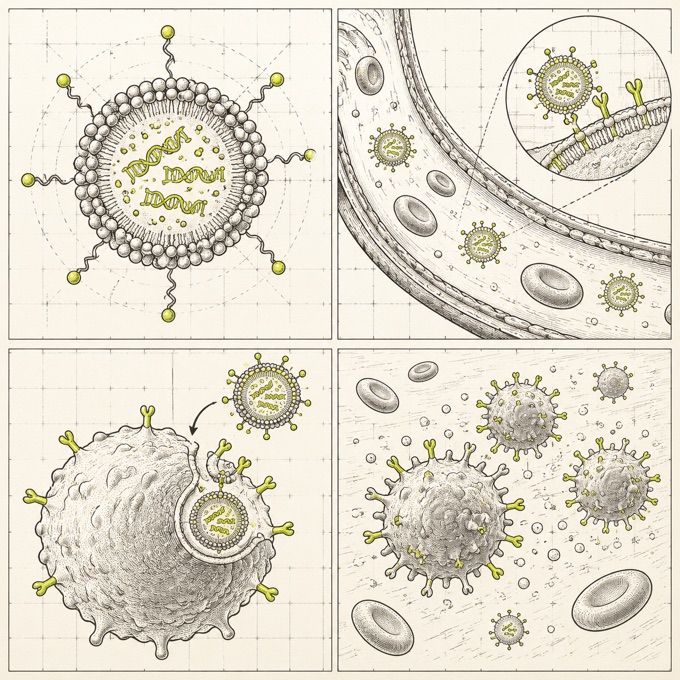
To eliminate the crippling bottlenecks of centralized cleanroom logistics, advanced molecular biology introduces a transformative paradigm: instead of extracting the patient's cells to transport them to a genetic factory, deliver the genetic machinery directly to circulating immune cells inside the living body. Under this in vivo framework, the patient's own vascular network serves as an autonomous bioreactor, converting endogenous lymphocytes into targeted cancer-fighting agents within hours following a standard intravenous infusion.
The foremost translational platform relies on targeted lipid nanoparticles, abbreviated as tLNPs. As detailed in our review on RNA vaccines and lipid delivery systems, conventional lipid nanoparticles naturally adsorb circulating apolipoprotein E and clear rapidly into hepatocytes via low-density lipoprotein receptors in the liver. To redirect this hepatic clearance toward immune tissues, researchers functionalize the outer lipid envelope by conjugating monoclonal antibodies, single-chain variable fragments (scFv), or nanobodies directed against specific T-cell surface markers, predominantly CD4 or CD8. Concurrently, they optimize ionizable lipid ratios and polyethyleneglycol surface densities to suppress passive liver uptake.
Encapsulated within these targeted nanoparticles is a synthetic messenger RNA payload encoding the complete chimeric antigen receptor architecture: an extracellular single-chain variable fragment recognizing the target epitope (most commonly CD19 for B-cell indications), a CD8-derived hinge and transmembrane segment, an intracellular costimulatory domain such as 4-1BB or CD28, and a CD3 zeta signaling tail. Once the tLNP docks onto a circulating T cell and fuses with the plasma membrane, the mRNA is released into the cytoplasm. Host ribosomes translate the message, displaying thousands of active CAR complexes across the cell surface within four to eight hours. Crucially, this expression is transient: because synthetic mRNA degrades naturally within 48 to 72 hours, CAR presentation wanes smoothly over several days, executing a hit-and-run cytotoxic ablation without permanently altering host genomic DNA.
The second engineering avenue harnesses viral vectors with retargeted envelopes, such as pseudotyped lentiviruses or enveloped delivery vehicles (EDVs). Viral structural engineers mutate envelope glycoproteins from measles virus or vesicular stomatitis virus to abrogate their native receptor tropism, replacing them with custom molecular adapters that bind specifically to human CD3 or CD8. Unlike transient mRNA delivery, integrating retroviral or lentiviral particles insert their genetic payload into the host genome, conferring lifelong CAR expression upon the transduced immune cells.
A landmark breakthrough published in Nature in 2026 by Nyberg, Jennifer Doudna, and Justin Eyquem proved that in vivo viral engineering can now achieve precise, site-specific genomic integration using CRISPR-Cas9 technology. By deploying a coordinated dual-vector architecture (enveloped delivery vehicles carrying Cas9 ribonucleoproteins to execute targeted double-strand breaks alongside adeno-associated viruses supplying the donor repair template), the researchers integrated a CAR transgene specifically into the endogenous TRAC locus within circulating T lymphocytes inside living animal models. This achievement unites the natural physiological transcriptional control of the native T-cell receptor promoter with the accessibility of intravenous administration, eliminating the insertional oncogenesis risks of random retroviral integration.
Preclinical primate evidence and early human clinical trials
The definitive pivot transforming in vivo CAR-T from an intriguing laboratory concept into an actionable clinical reality occurred with the 2025 publication in Science led by Hunter, Carl June, and the research team at Capstan Therapeutics. The investigators conducted exhaustive translational evaluations of CD8-targeted tLNPs carrying anti-CD19 CAR mRNA across healthy human peripheral blood mononuclear cells, clinical specimens from patients with severe autoimmune diseases, humanized mouse models of lymphoma, and non-human primates (cynomolgus macaques, Macaca fascicularis).
The quantitative data generated in non-human primates demonstrated striking in vivo potency following a single intravenous infusion without lymphodepleting chemotherapy. As depicted in the data chart above, within 72 hours of administration, between 30% and 45% of circulating CD8+ T lymphocytes in peripheral blood robustly expressed the functional anti-CD19 CAR. This in situ cellular expansion triggered near-total clearance of peripheral and lymphoid B cells: by day 14 post-infusion, B-cell counts plunged by over 99%, reaching a profound nadir below 5 cells per microliter in peripheral blood and lymph nodes.
The most consequential discovery of the Science investigation was the demonstration of complete immune system reset. In conventional autologous CAR-T utilizing permanently integrating lentiviruses, B-cell aplasia often persists for years or indefinitely, leaving recipients permanently dependent on monthly intravenous immunoglobulin infusions to survive routine community infections. In sharp contrast, with the transient mRNA tLNP system, once the mRNA payload naturally cleared and CAR expression faded, healthy bone marrow progenitors began replenishing the B-cell compartment between day 45 and day 60.
Extensive multiparametric flow cytometry revealed that over 85% of the emerging B cells exhibited an antigen-naive phenotype (IgD-positive and CD27-negative). This finding confirms that the transient in vivo CAR pulse eradicated the autoreactive memory B-cell clones driving chronic disease, allowing the immune system to re-emerge naive and tolerant without imposing lifelong humoral immunosuppression.
In clinical medicine, early human Phase 1 and Phase 1/2 exploratory trials launched between 2024 and 2026 have rapidly expanded this in vivo strategy into severe refractory autoimmune diseases. Key active trials include Arnovie101 (NCT07629596), evaluating an mRNA-LNP in vivo CAR-T candidate for systemic lupus erythematosus (SLE) and autoimmune hemolytic anemia, the IASO207 trial (NCT07617740) for active refractory SLE, and clinical reports in premier medical venues such as the New England Journal of Medicine documenting in vivo lentiviral delivery in autoimmune neurological disorders (Cheng et al., NEJM 2026). Initial human cohorts confirm rapid serological clearance of pathogenic autoantibodies (anti-dsDNA and ANA), profound decreases in SLEDAI disease activity scores, and resolution of lupus nephritis without requiring intensive care admissions.
Safety horizons, genomic integration, and the 2026 clinical landscape
Reprogramming human immune cells directly within the vascular tree demands uncompromising clinical vigilance. The most critical safety hazard across any T-cell engagement therapy is cytokine release syndrome (CRS), an inflammatory cascade precipitated by massive secretions of interleukin 6, interferon gamma, and tumor necrosis factor when millions of activated lymphocytes engage their targets. In conventional ex vivo CAR-T, CRS frequently manifests as a dangerous storm because billions of pre-expanded, highly activated cells are dumped into the circulation simultaneously. In contrast, the in vivo kinetic profile is inherently asynchronous: vector uptake and receptor expression occur over 24 to 48 hours, blunting peak inflammatory cytokine concentrations and markedly diminishing high-grade neurotoxicity.
A second crucial consideration is cellular selectivity: preventing off-target expression should a nanoparticle or viral vector be internalized by hepatocytes, endothelial cells, or macrophages. To establish redundant layers of biological safety, molecular engineers integrate microRNA target sequences into the 3 prime untranslated region of the CAR construct. By incorporating complementary binding sites for non-T cell microRNAs (such as liver-specific miR-122 or myeloid-specific miR-142), any mRNA that enters off-target cells is degraded by endogenous RNA-induced silencing complexes, ensuring CAR translation occurs exclusively within authentic T lymphocytes.
| Therapeutic Modality | Cell Manufacturing & Turnaround Time | Conditioning Chemotherapy Required? | Genomic Integration & Persistence | Graft-versus-Host Disease (GvHD) Risk | Regulatory Status (November 2026) |
|---|---|---|---|---|---|
| Autologous Ex Vivo CAR-T (Kymriah, Yescarta, Carvykti) | Centralized cleanroom; 3 to 6 weeks vein-to-vein delay | Yes, mandatory (high-dose fludarabine and cyclophosphamide) | Random viral genomic integration; multi-year persistence | Zero (autologous patient-derived lymphocytes) | 6 commercially approved therapies in hematologic oncology |
| Allogeneic Ex Vivo CAR-T (Universal healthy donor cells) | Pre-manufactured cryopreserved vials; rapid off-the-shelf access | Yes, highly intensive (to suppress host immune rejection) | Multiplex gene editing (knockout of TRAC and B2M / CD52) | Mitigated by TRAC disruption, but persistent risk | Phase 1/2 exploratory oncology trials; 0 approved therapies |
| Transient In Vivo CAR-T (Anti-CD8 tLNP-mRNA / Capstan) | Zero weeks; standard off-the-shelf intravenous vial | Zero conditioning chemotherapy required | 0 genomic breaks; transient mRNA with complete immune reset | Zero (reprograms host lymphocytes exclusively in situ) | Phase 1/2 trials in autoimmunity and oncology (NCT07629596); 0 approved |
| Integrating In Vivo CAR-T (EDV-CRISPR / AAV TRAC targeting) | Zero weeks; dual-vector intravenous infusion directly into patient | Under investigation; potentially optional or minimal conditioning | Site-specific homology-directed repair at TRAC locus; permanent | Zero (host lymphocytes modified in situ without donor cells) | Advanced preclinical proof-of-concept in animal models (Nature 2026) |
The comparative matrix above delineates two distinct clinical niches for the future of genetic medicine. In chronic autoimmune diseases such as systemic lupus erythematosus, systemic sclerosis, and inflammatory myositis, the clinical objective is not permanent immune destruction, but rather a temporary, deep sweep of autoreactive memory B-cell clones to permit the bone marrow to reboot a naive, self-tolerant repertoire. In this setting, transient mRNA tLNPs provide the ideal therapeutic profile due to their self-limiting kinetics and lack of permanent genomic changes. Conversely, in relapsed or refractory hematological malignancies where durable immunosurveillance is required to eliminate dormant cancer stem cells, permanent site-specific TRAC integration via in vivo CRISPR vectors will serve as the definitive solution.