neobiologia ATLAS OF THE NEW BIOLOGY
ESENZH
EXTRA PLATE / EPIGENOME 0 DNA CUTS · ~1 YEAR MEMORY
SILENCE
FLIPPING THE SWITCH WITHOUT TOUCHING THE LETTERS
ATGCCTAGCGTACG TACGATCAGTCAGT CGATCGTAACGTAC
ANALYSIS · 8 MIN · VERIFIED 19 OCTOBER 2026

Durable epigenetic silencing: turning genes off without cutting DNA

Programmable epigenetic silencing turns off a target gene by depositing CpG methylation marks onto its promoter without cutting the double helix or altering a single DNA base. Delivered transiently as mRNA in lipid nanoparticles, the editor vanishes within days while hepatocytes copy the chemical lock across cell divisions for nearly a year.

DNA STRAND BREAKS
Zero (A-T-G-C sequence intact)
IN VIVO PROOF
Mouse PCSK9 · ~1 year (Nature 2024)
MITOTIC MEMORY
≥450 cell divisions in vitro
CLINICAL STATUS
Phase 1/2 (OTX-2002) · 0 approved
0DOUBLE-STRAND BREAKS
~75%PEAK PCSK9 DROP IN MICE
330 DAYSDURATION AFTER 1 LNP DOSE
≥450DIVISIONS WITH MEMORY IN VITRO
01
THE SCISSORS TOLL

Why cutting the double helix carries a price

As shown in Plate 01 (CRISPR), first-generation genome editing works like molecular scissors: Cas9 cuts both strands of the DNA double helix, and the cell's hurried repair machinery introduces small insertions or deletions that disable the target gene. In approved ex vivo medicines such as Casgevy, that deliberate cut transforms care for sickle-cell disease.

Yet cutting the genome carries biological overhead. Double-strand breaks can trigger large deletions, chromosomal translocations, or p53 DNA-damage responses, particularly when editing multiple loci at once. And once a nucleotide letter is deleted from a chromosome, there is no undo button.

That limitation prompted a different engineering question: since human cells already silence thousands of genes in every tissue using DNA methylation, can we send a temporary messenger to install that exact chemical padlock on a single disease-driving gene and leave the underlying letters untouched?

02
HIT-AND-RUN EPIGENOME EDITING

An editor that lasts days, a silence that lasts a year
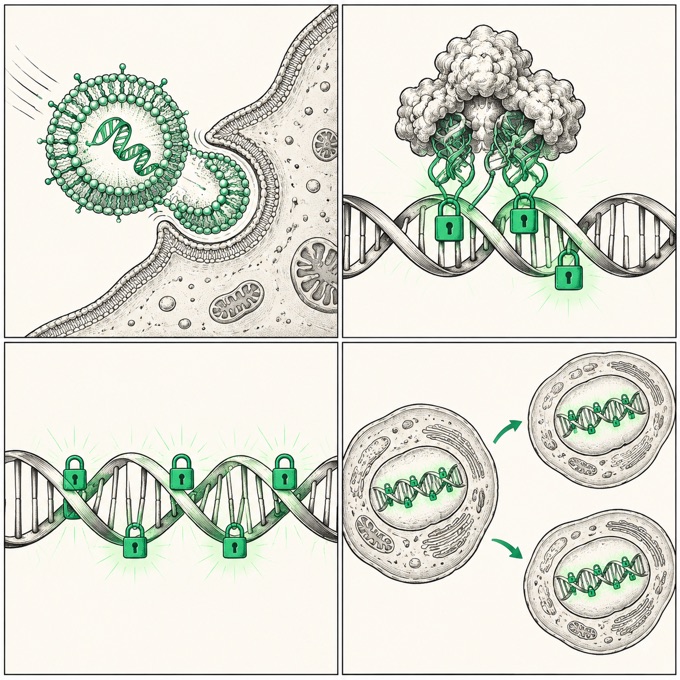
Four panels: lipid nanoparticle entering a hepatocyte with mRNA, zinc-finger protein placing emerald methyl padlocks onto intact DNA, silenced gene without strand breaks, and dividing cell passing the methyl padlocks to both daughter cells
1. A lipid nanoparticle delivers transient mRNA · 2. The DNA-binding complex deposits CpG methyl padlocks without cutting the helix · 3. The promoter coils shut · 4. When the hepatocyte divides, daughter cells copy the padlock. Conceptual plate.

For a decade, the bottleneck was permanence: if a transcriptional repressor is delivered safely as messenger RNA, the protein disappears in a few days. Early designs lost their effect as soon as the editor cleared.

In 2021, Jonathan Weissman, Luke Gilbert, and colleagues showed in Cell with CRISPRoff that fusing three epigenetic effector domains (DNMT3A, DNMT3L, and KRAB) to a catalytically dead Cas9 (dCas9) wrote a methylation state that persisted across more than 450 cell divisions in vitro, even as induced pluripotent stem cells differentiated into neurons.

The decisive in vivo test arrived in February 2024 in Nature. Angelo Lombardo, Martino Alfredo Cappelluti, and colleagues at the San Raffaele Telethon Institute for Gene Therapy engineered evolved transcriptional repressors built on zinc-finger DNA-binding proteins (EvoETR) targeting hepatic Pcsk9 in mice, the master regulator of LDL cholesterol removal.

DATA FIGURE · HEPATIC PCSK9 SILENCING AFTER A SINGLE mRNA-LNP DOSE (NATURE 2024) Circulating PCSK9 relative to control (%) 100% 50% 25% 0% Unedited control (100%) First-generation ETR (~50% reduction) Optimized EvoETR (up to ~75% sustained reduction) Partial hepatectomy (forced liver regeneration) Daughter hepatocytes inherit CpG methylation lock Day 0 (1 LNP dose) Day 90 Day 180 Day 330 (~11 months) Source: Cappelluti et al., Nature 627:416, 2024 (doi:10.1038/s41586-024-07087-8). Zero DNA double-strand breaks.

A single intravenous infusion of lipid nanoparticles carrying the editors' mRNA cut circulating PCSK9 levels by roughly half for nearly one year (330 days), while the optimized all-in-one EvoETR architecture maintained up to a 75% reduction with high genome-wide specificity. To prove that the silent state was genuinely heritable across cell division in a living organ, the team performed partial hepatectomy to force liver regeneration: newly divided hepatocytes copied the CpG methylation marks and kept Pcsk9 switched off.

PRIMARY SOURCES: Cappelluti et al., Nature 627:416-423, 2024, Nature (10.1038/s41586-024-07087-8) · Nuñez et al., Cell 184:2503-2519, 2021, Cell (10.1016/j.cell.2021.03.025).
03
FOUR MODALITIES COMPARED

Cut, swap a base, rewrite, or silence

Four programmable genetic tools now sit on the bench. They solve different problems: if a patient carries a broken letter that makes a toxic protein, base or prime editing can fix the spelling; if the clinical goal is turning down a normal gene whose output is too high (such as PCSK9 in hypercholesterolemia or the MYC oncogene in liver tumors), epigenetic silencing avoids nicking or cleaving the DNA backbone altogether.

ModalityCuts DNA strands?Alters A-T-G-C sequence?Reversible?Regulatory status (Oct 2026)
CRISPR-Cas9 nucleaseYes, double-strand break (DSB)Yes (indels during repair)No (permanent sequence change)1 approved ex vivo (Casgevy, 2023); in vivo BLA accepted (lonvo-z, PDUFA Mar 2027)
Base editingSingle-strand nick (nickase)Yes (converts 1 base: C to T or A to G)Only via re-editingPhase 1/2 clinical trials (e.g. VERVE-101/102 on PCSK9); 0 approved
Prime editingSingle-strand nick (nickase)Yes (writes short stretches via reverse transcriptase)Not in clinical practiceEarly Phase 1 trials; 0 approved
Epigenetic silencing (EvoETR / CRISPRoff)No (0 cuts)No (0 bases changed)Yes (targeted demethylation via TET1)Phase 1/2 in humans (OTX-2002 on MYC, NCT05497453); PCSK9 in preclinical

A 2026 review in Clinical Epigenetics benchmarks three milestones that moved epigenetic editing toward the clinic between 2024 and 2026: mechanistic durability (silencing maintained across at least 450 cell divisions in vitro and 12 months in vivo without continued editor expression), tissue-selective delivery above 50% efficiency in liver, muscle, and brain via lipid nanoparticles and AAV vectors, and first-in-human trials led by OTX-2002 (the MYCHELANGELO Phase 1/2 study targeting MYC in hepatocellular carcinoma, NCT05497453).

The honest boundary in 2026: silencing Pcsk9 for a year in mice proves that hit-and-run epigenetic inheritance works in vivo, but mouse livers are not human clinics. No epigenetic editor is approved today for lowering cholesterol or treating cancer.
TRANSLATIONAL REVIEW: Clinical Epigenetics, 2026, Clinical Epigenetics (10.1186/s13148-026-02194-x) · OTX-2002 trial record: NCT05497453.
2021CRISPROFF: ≥450-DIVISION MEMORY IN CELL
2024EVOETR SILENCES PCSK9 ~1 YEAR IN MICE (NATURE)
NCT05497453OTX-2002 IN PHASE 1/2 HUMAN TRIAL
0EPIGENETIC EDITORS APPROVED TODAY
How does epigenetic silencing differ from classic CRISPR-Cas9?
Classic CRISPR-Cas9 cuts both strands of the DNA helix to disable a gene, and base editing chemically converts a single nucleotide letter. Epigenetic silencing neither cuts DNA nor changes any A, T, G, or C letter: it deposits CpG methylation and repressive histone marks onto the gene's promoter so the cell stops transcribing it.
Does the silencing last if the mRNA editor degrades within days?
Yes. That durability barrier was solved in vivo in 2024 (Cappelluti et al., Nature). A single lipid nanoparticle dose carrying mRNA for evolved zinc-finger transcriptional repressors (EvoETR) lowered circulating PCSK9 protein by 50% to 75% for nearly a year (330 days) in mice, even though the mRNA vanished within days. The cell's own maintenance methyltransferases copy the CpG lock each time the hepatocyte divides.
Can epigenetic silencing be reversed?
In principle, yes. Because the underlying DNA sequence remains untouched, a targeted epigenetic activator (such as dCas9-TET1 or CRISPRon) can strip the methyl marks from the promoter and turn the gene back on, something impossible once a nuclease has deleted or rewritten bases.
Are any epigenetic editors approved by the FDA or EMA?
No. As of October 2026, no epigenetic editing therapy has regulatory approval. The furthest clinical program is OTX-2002 (Phase 1/2 MYCHELANGELO trial, NCT05497453, targeting the MYC oncogene in hepatocellular carcinoma), while PCSK9 cholesterol-lowering editors remain in late preclinical development.
EvoETREvolved engineered transcriptional repressor using zinc fingers to install CpG methylation without cutting DNA
CRISPRoffDead Cas9 fused to DNMT3A/3L and KRAB that writes heritable gene silencing
PCSK9Hepatic protein that degrades LDL receptors; silencing it lowers blood LDL cholesterol
Hit-and-runDelivery strategy where transient mRNA expresses the editor for days, leaving a permanent epigenetic mark

Continue here