Why linear mRNA clears fast and how saRNA and circRNA extend the clock
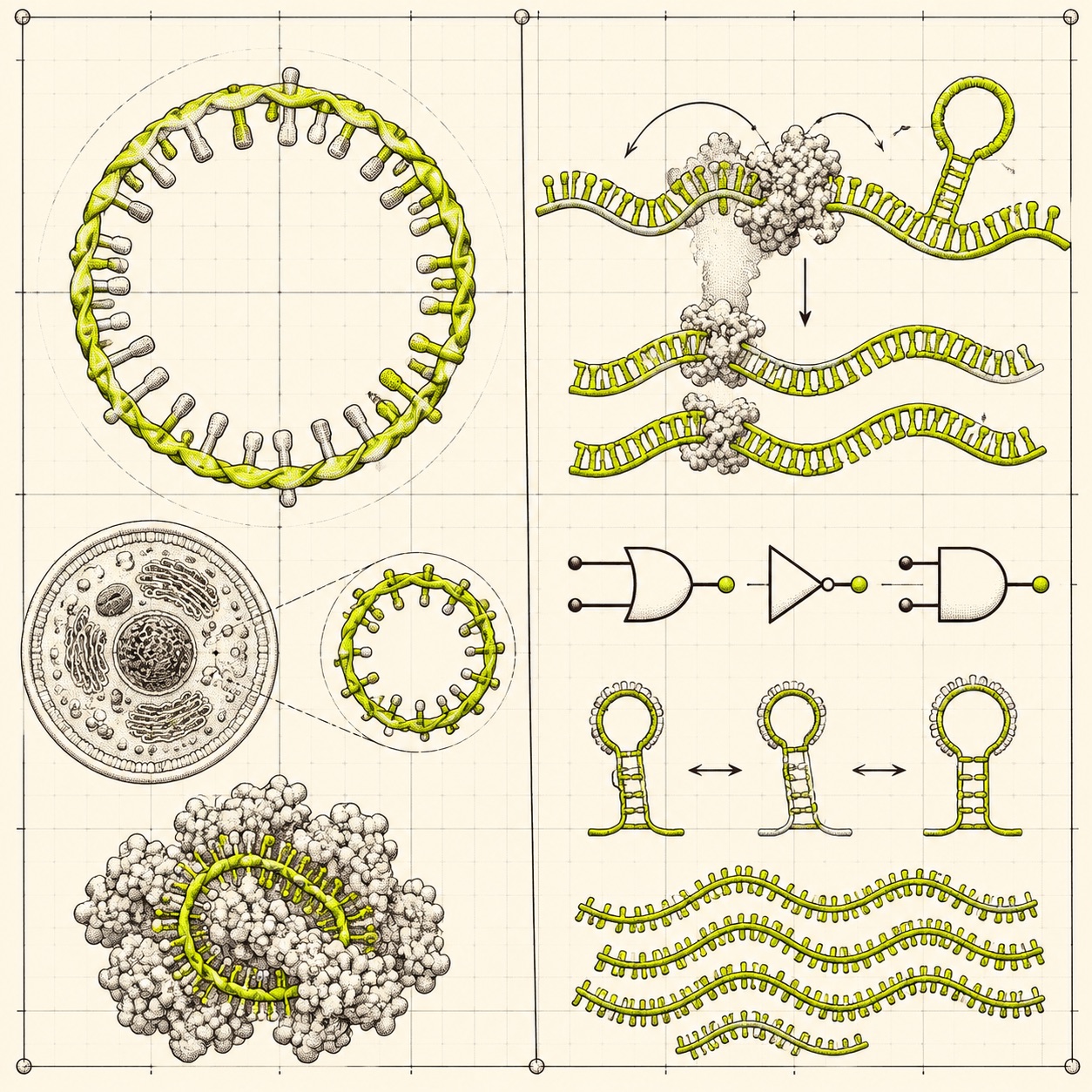
Readers starting from our primer on how RNA vaccines work quickly encounter an engineering bottleneck: if conventional messenger RNA breaks down inside the cytoplasm within a few days, how can bioengineers sustain protein output without integrating into genomic DNA or injecting high lipid doses every week?
Linear mRNA decays quickly because of its two open ends. Every synthetic linear transcript carries a 5' cap and a 3' poly(A) tail. Inside the cell, decapping enzymes and cytoplasmic exonucleases chew inward from both ends, causing protein translation to peak within 6 to 24 hours and drop toward baseline by day 3 or 4. Standard vaccines compensate with 30 to 100 microgram doses and N1-methylpseudouridine substitution.
Two distinct RNA architectures overcome this limit. Self-amplifying RNA (saRNA) remains linear but encodes four alphavirus non-structural replicase proteins ahead of the target gene. Once translated, that replicase copies subgenomic antigen transcripts inside the cytosol, amplifying protein yield from tiny initial doses. Circular RNA (circRNA) takes the opposite route: instead of replicating, it joins its 3' and 5' termini covalently through autocatalytic intron splicing or enzymatic ligation, leaving zero free ends for exonucleases while recruiting ribosomes via an internal ribosome entry site (IRES).
The double-stranded RNA sensor wall, m6A masking, and ARCT-154 clinical proof
Both saRNA and circular RNA confront the cell's antiviral perimeter: innate sensors RIG-I, MDA5, and PKR detect double-stranded RNA (dsRNA) intermediates and residual foreign splice sequences. When dsRNA crosses the activation threshold, PKR phosphorylates eIF2 alpha to halt global translation while OAS/RNase L and type I interferons degrade the payload before therapeutic protein accumulates.
In circular RNA engineering, landmark mechanistic papers in Molecular Cell (2017, intron identity sensing) and Molecular Cell (2019, m6A modification) showed why purification and scarless design dictate tolerability: leftover linear transcripts and foreign bacterial intron scars trigger RIG-I, whereas N6-methyladenosine (m6A) marks and scarless splicing suppress aberrant immune activation without blocking IRES translation. In Cell (2022), an engineered circular RNA RBD vaccine sustained antigen expression longer and proved more thermostable than modified linear mRNA in animal challenge models.
Meanwhile, self-amplifying RNA crossed into commercial human medicine with ARCT-154 (Kostaive), reviewed in Human Vaccines & Immunotherapeutics (2025). Delivered at just 5 micrograms per booster (one-sixth of the 30-microgram linear BNT162b2 dose), the randomized head-to-head trial published in The Lancet Infectious Diseases (2024) demonstrated superior 12-month neutralizing antibody persistence against SARS-CoV-2 variants. The key tradeoff is biological: viral replicases cannot efficiently copy templates fully substituted with N1-methylpseudouridine, requiring careful lipid and sequence tuning to balance early reactogenicity against dramatic dose sparing.
Synthetic biology logic gates and engineered cell biosensors
Whereas circularization sets how long an RNA signal lasts and replicases set how strongly it amplifies, synthetic biology genetic circuits govern where and when expression turns on. As framed by Nature Reviews Genetics (2010, Khalil & Collins), engineered cells and RNA switches wire promoters, repressors, and toehold RNA hairpins into Boolean logic gates.
Two quantitative applications illustrate how logic gates solve real failure modes:
- AND / NOT tissue-gating in RNA therapeutics: Rather than translating a potent cytokine or CAR receptor in every organ that absorbs an LNP, an RNA logic circuit requires two simultaneous inputs (for example, detecting tumor-enriched microRNA A while gated off by a NOT sensor for healthy-hepatocyte microRNA B), keeping off-target liver activity silent.
- Engineered cellular and bioelectronic biosensors: Biosensors & Bioelectronics (2013, Wang et al.) demonstrated modular whole-cell bacterial biosensors executing AND logic to flag heavy-metal pollutants only above strict combined cutoffs, while Science (2018, Mimee et al.) paired heme-sensing engineered probiotic bacteria with ultra-low-power microelectronics inside an ingestible capsule that wirelessly detected gastrointestinal bleeding in swine.
Live ClinicalTrials.gov ledger: approved saRNA vs. first-in-human circRNA
To separate preclinical hype from human translation, we queried the public ClinicalTrials.gov REST API v2 on 2026-11-23. Self-amplifying RNA now spans Phase 1 oncology trials to 19,000-person Phase 3 vaccine cohorts, whereas therapeutic circular RNA has just entered its initial Phase 1 human safety trials in cardiac, metabolic, and autoimmune indications.
| NCT Registry | Platform | Indication / Lead Sponsor | Phase & Enrollment | Status (2026-11-23) |
|---|---|---|---|---|
| NCT05012943 | saRNA (ARCT-154-01) | COVID-19 vaccine efficacy · Arcturus Therapeutics | Phase 2/3 · n=19,474 | Completed |
| NCT06602531 | Pandemic saRNA | Pandemic influenza · Arcturus Therapeutics | Phase 1/2 · n=212 | Completed |
| NCT07652242 | saRNA (ITI-5000) | Stage 2-3 triple-negative breast cancer · Immunomic | Phase 1 · n=60 | Recruiting |
| NCT06799013 | saRNA (repRNA) | Crimean-Congo hemorrhagic fever · HDT Bio | Phase 1 · n=48 | Recruiting |
| NCT06621576 | circRNA (HM2002) | Epicardial CABG injection · Ruijin Hospital | Early Phase 1 · n=3 | Completed |
| NCT07347080 | Exenatide circRNA | Single ascending metabolic dose · Henan Univ. | Early Phase 1 · n=9 | Recruiting |
| NCT07765966 | circRNA (RXIM002) | Autoimmune cytopenias · RiboX Therapeutics | Phase 1 · n=27 | Not yet recruiting |