The right molecule into the right cell
The question sounds trivial and is not: how do you deliver? CRISPR editing needs the cutting machinery to reach the target cell's nucleus. Gene therapy needs the transgene to enter without triggering a devastating immune response. RNA vaccines need the RNA to cross the membrane intact. In all three cases the science of the molecule runs ahead of the logistics of the molecule.
Lipid nanoparticles (LNPs) solved this for RNA and took the 2023 Nobel Prize in Medicine. But LNPs have a liver bias: they tend to end up in the liver, which is perfect for liver disease and a limitation for nearly everything else. And they do not reliably carry folded proteins. That is where the Munich paper enters.
A plant cage with a calculated key
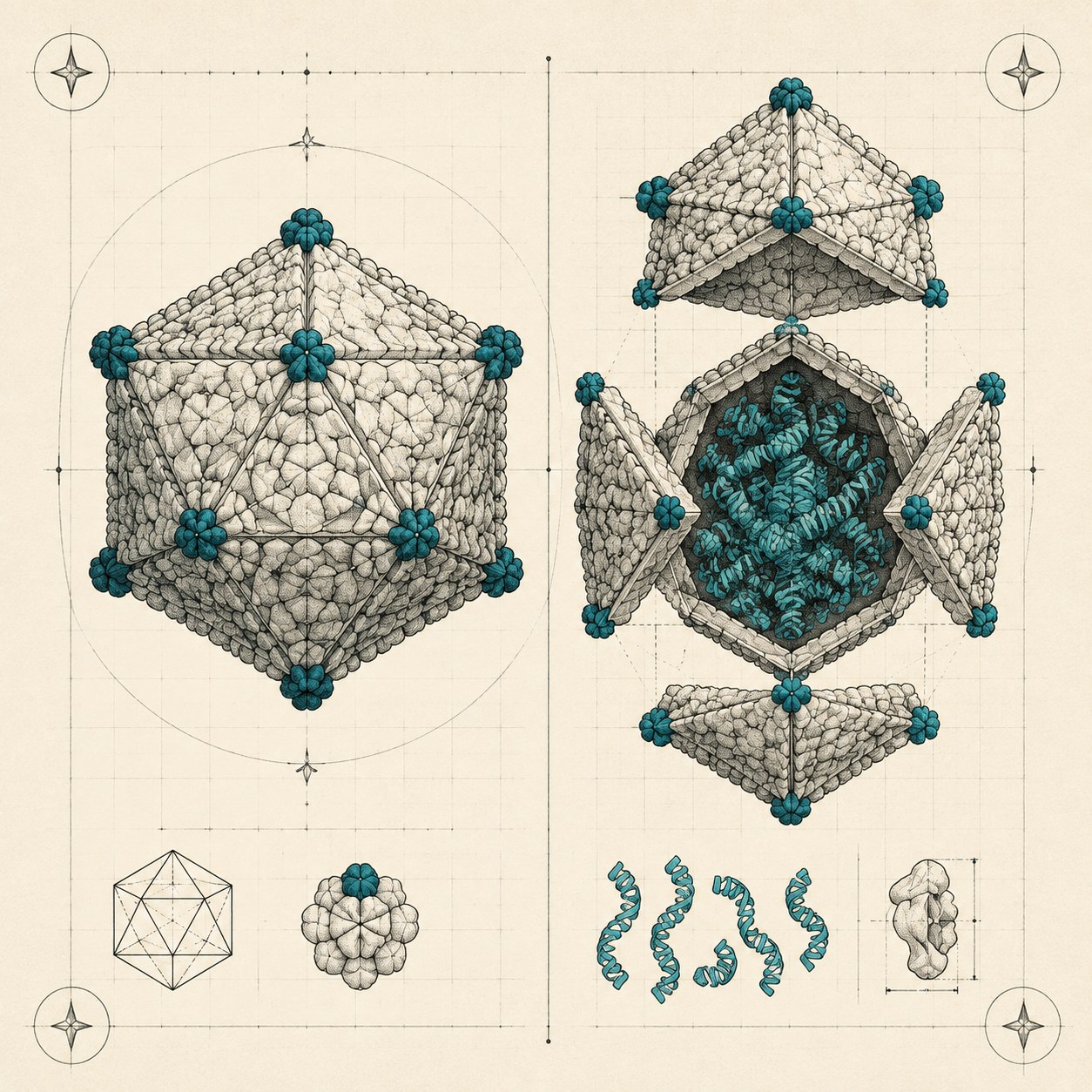
The starting point is not artificial: it is the capsid of the tomato black ring virus (STV? see note), a plant virus whose protein cage is small, stable, and self-assembling. The authors turned it into a platform in three moves: first they emptied the cage of its viral genome; then they used computational design (the RFdiffusion family of tools) to design a binder protein that clips onto the capsid surface on one side and a chosen cell receptor on the other; third, they loaded the cage with cargo proteins through an anchoring system that ties the cargo to the capsid interior.
The result is a vehicle with the address written on its surface. This is not directed evolution or blind engineering: it is specify the cellular target first, then calculate the structure that recognizes it. The design was validated in cell culture (delivery in human lines) and in mouse (distribution and tissue delivery). No further.
An honest list

What it solves. Manufacturing: the capsid is produced in bacteria, cheap and scalable, no mammalian cell culture. Assembly: it builds itself, no complex conjugation steps. Protein cargo: the internal anchoring system packages folded proteins, which LNPs do poorly. Direction: the calculated binder gives affinity for a chosen receptor, in principle swappable.
What it does not solve. Immunogenicity: a viral capsid is foreign to the immune system, and early responses in mouse were detectable. Cargo size: the cavity is small; large proteins or multiprotein complexes still do not fit. GMP production: none of this has been manufactured under clinical standards. And above all, there are no human data: no safety, no pharmacokinetics, no efficacy. It is a design milestone, not a medicine.
| Delivery vehicles compared | Typical cargo | Main advantage | Main limit |
|---|---|---|---|
| Lipid nanoparticle (LNP) | mRNA, siRNA | Clinically proven (COVID vaccines) | Liver bias; folded proteins: no |
| AAV (gene therapy) | Single-stranded DNA | Approved in several diseases | Tiny capacity; pre-existing immunity |
| VLP / redesigned capsids | Proteins, complexes | Self-assembly, bacterial production | Immunogenicity; small cargo |
| Computational STV (2026) | Folded proteins | On-demand calculated targeting | No human data; mouse validation |
The pattern worth recognising: every delivery vehicle in recent history has followed the same arc, from the COVID vaccine LNP to this paper's STV: first design validation in animals, then the first hepatic or local indication (the easiest one), and only at the end systemic medicine for a specific organ. Skipping the middle steps is where delivery platforms go to die.